Structural Dynamics coursework
As part of my undergraduate studies, I undertook a Master's level structural dynamics course at Universität Duisburg-Essen. The coursework produced focused on the dynamic behaviour of structures under seismic excitation. The work was structured around both analytical reasoning and computational modelling to understand how structural systems respond to dynamic loads, and how modelling assumptions influence predicted behaviour and engineering decisions.
The central case study involved a slender water tower subjected to seismic input. A multi-level modelling strategy was adopted to explicitly connect simplified analytical approximations with detailed finite-element simulations. An initial single-degree-of-freedom (SDOF) abstraction was formulated by concentrating mass at the tank level and representing lateral stiffness through the supporting structure. From this formulation, natural frequencies were derived from stiffness estimates obtained via finite-element deformation and mass properties derived from geometry and material density.
Complementing analytical assumptions with identified system behaviour, a free-vibration decay test was analysed using the logarithmic decrement method to estimate the damping ratio from observed response data. This provided a data-grounded estimate of dissipation, reducing reliance on assumed damping values and making the model behaviour more closely tied to measurable phenomena.
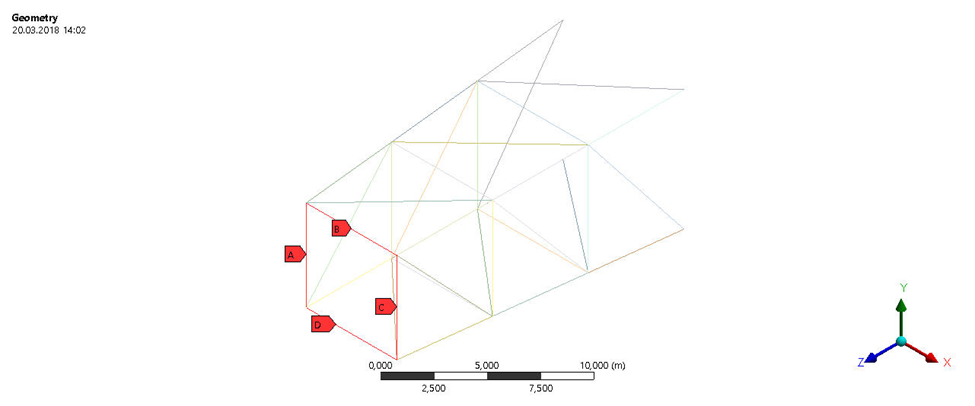
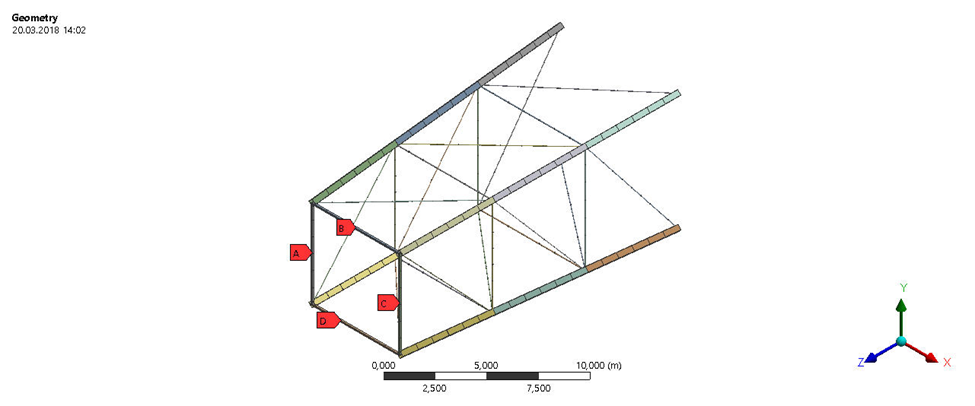
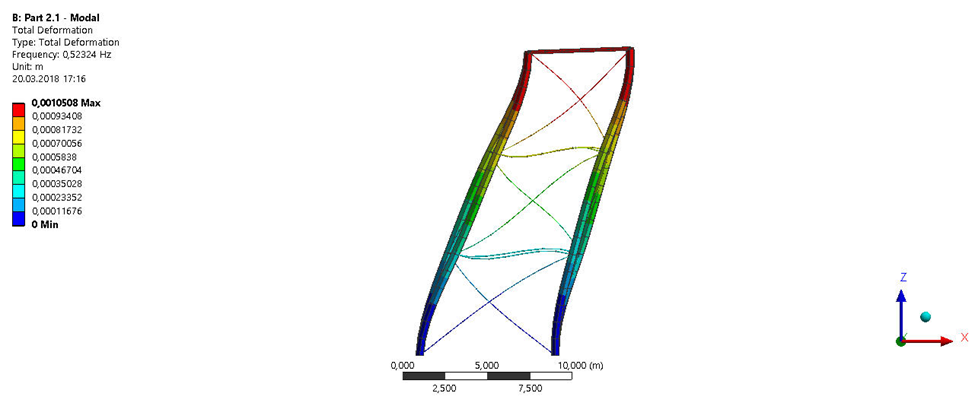
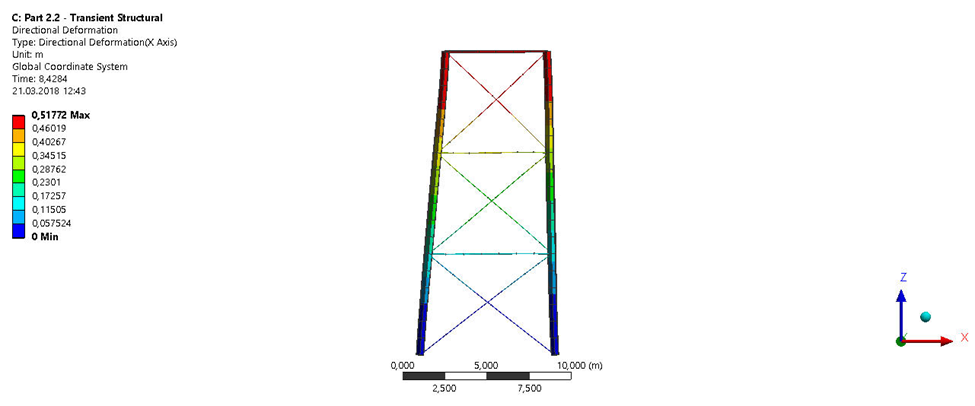
For numerical analysis, a three-dimensional beam model of the tower was developed in ANSYS, representing distributed mass effects and material stiffness. Modal analysis was used to extract fundamental vibration modes and confirm the SDOF approximation, while transient dynamic simulations reproduced the free-vibration tests numerically, linking damping estimates, numerical time-step selection, and solution stability. Finally, a response spectrum analysis based on the relevant seismic design standard was performed to estimate demands such as base shear and bending moment distributions under design level excitation.
Differences between simplified and numerical results remained within expected engineering tolerances, reinforcing the utility of systematic model hierarchy in engineering reasoning.