Emova Digital Twin
This project was developed as an innovation pilot in collaboration with EMOVA, the operator of the Buenos Aires metro — the first metro system in Latin America, in continuous operation for 112 years. The goal was to explore how digital twin concepts could meaningfully support rolling stock maintenance, starting from a single asset and its real maintenance processes, rather than from a fully defined technical specification.
From the outset, the work was organized as an iterative, client-embedded process. Instead of prescribing a solution upfront, we worked closely with EMOVA's technical and operational teams through user stories, workshops, and structured review sessions. The scope was allowed to evolve in response to actual maintenance practices, constraints, and information needs, rather than abstract assumptions about technology. A workshop on Digital Twins for asset management, covering BIM fundamentals (ISO 19650), international reference cases, COBie, and Deutsche Bahn's predictive maintenance approach, helped align expectations across maintenance, engineering, and IT.
The pilot focused on the Alstom Metropolis B PB1 bogie of EMOVA's CNR trainsets, and specifically on the preventive maintenance routine performed every 6,250 km. Three subprocesses were digitalized end-to-end: 5.10.1 Frame, 5.10.2 Wheelset and pneumatic disc brake, and 5.10.3 Traction motors.
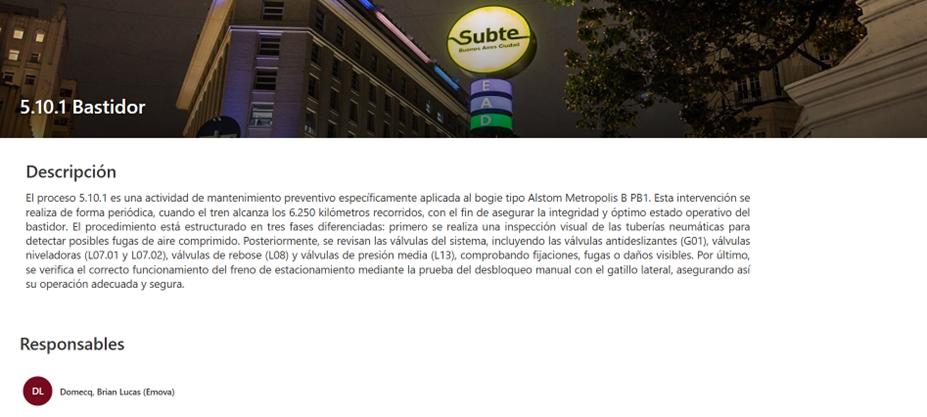
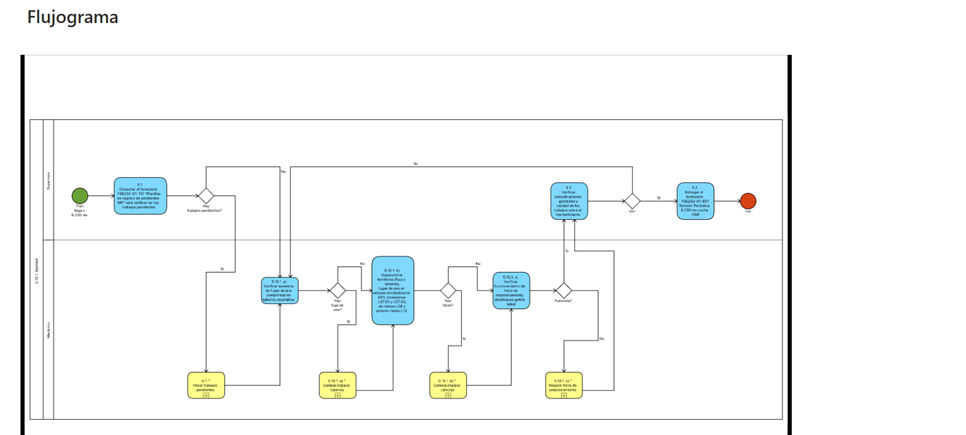
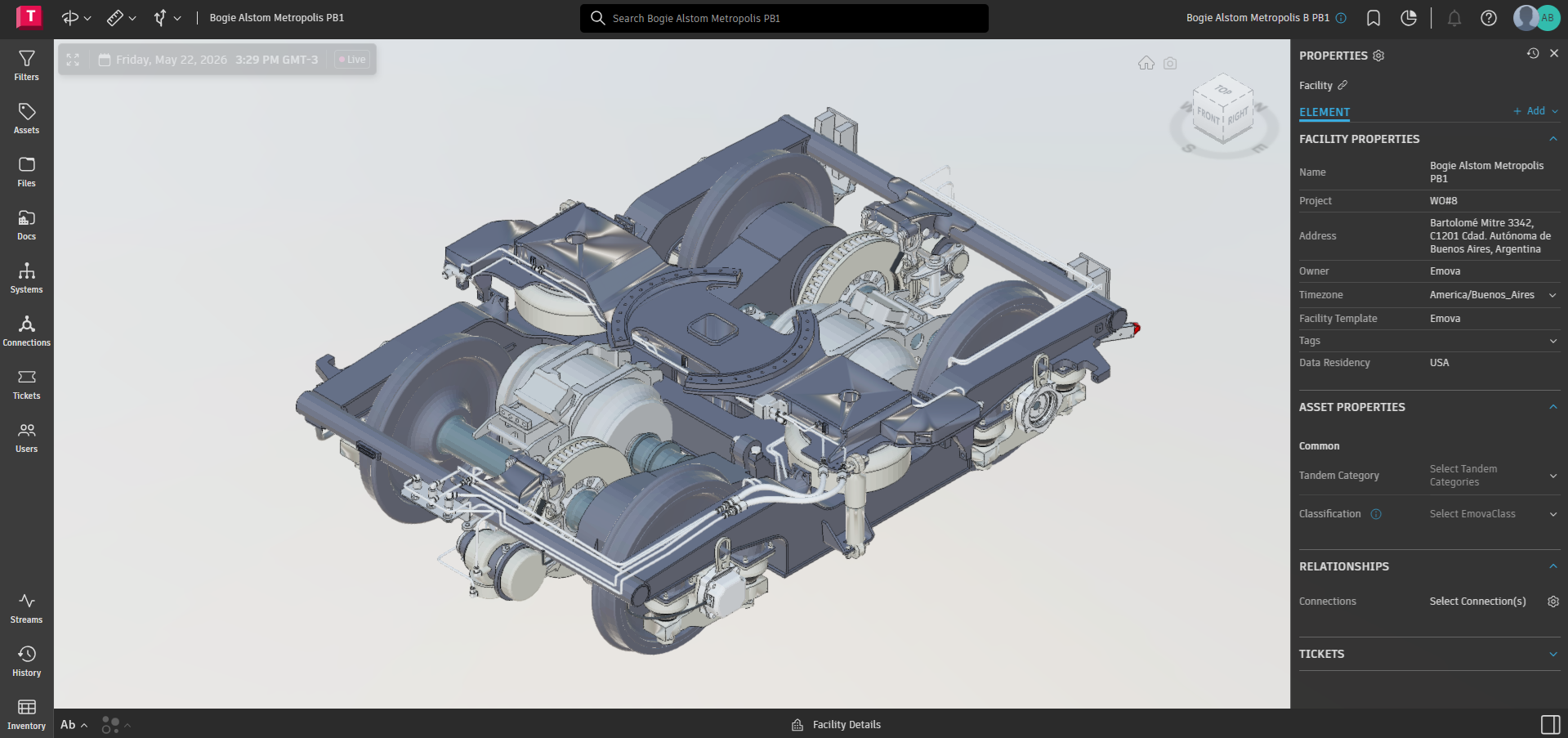
The deliverable combined three complementary layers. A BPM platform built on Microsoft SharePoint formalized the maintenance workflows, inspection checklists, and decision points, replacing paper-based and dispersed documentation. A BIM model of the bogie was structured in Autodesk Tandem as an informational digital twin, with each component carrying its own attributes — asset code, car code, trainset code, serial number, manufacturer, maintenance frequency, LOD, and direct links to its maintenance sheet and BPM process. Finally, a custom API connected the digital checklist responses (MS Forms) back to the specific component in the twin, making the inspection history queryable from the 3D model and creating an auditable record at component level.
A complementary VR application was developed in Unity 2021.3 LTS using the VR Interaction Framework, targeting Meta Quest 3. The 1:1 immersive representation of the bogie lets technicians in training walk through the inspection procedure following the same component hierarchy as the field checklist, without having to immobilize a trainset in the workshop or expose themselves to confined spaces and energized equipment. The Android executable and the open development stack make the solution portable and migratable to WebXR in the future.
A central lesson from this project is that digital twins, as commonly discussed, remain embryonic in practice. Static models and single-source data offer limited value. Meaningful impact arises when geometric, procedural, and operational data are correlated and continuously updated, and when the twin is anchored in a specific maintenance process that is itself worth digitalizing.